
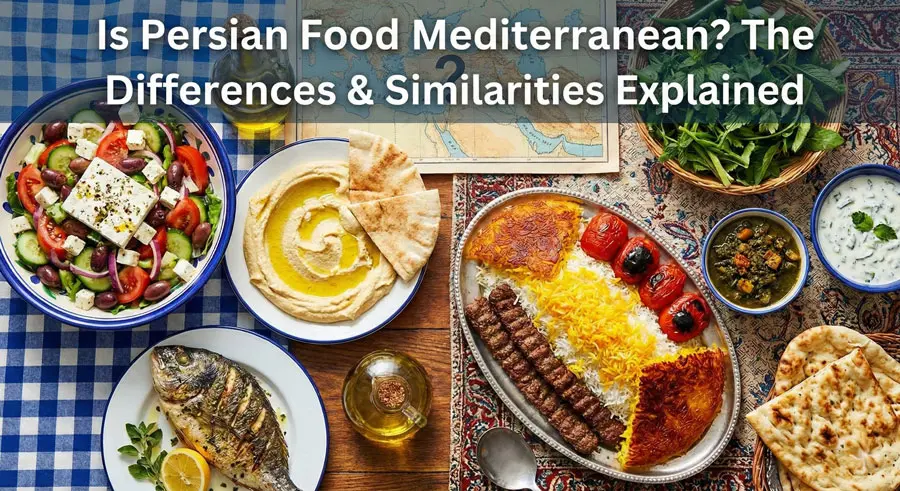
Is Persian Food Mediterranean? The Differences & Similarities Explained
If you look at a map, you won’t find Iran bordering the Mediterranean Sea. Yet, when you look at a plate of Persian food—packed with fresh herbs, grilled meats, and yogurt—it looks strikingly similar to Greek or Lebanese cuisine.
So, is Persian food Mediterranean?
The short answer is: Geographically, no; but culinarily, yes. Technically, Iran is a Middle Eastern country, not a Mediterranean one. However, the Persian diet shares the same healthy DNA as the Mediterranean diet: a focus on heart-healthy fats, plant-based ingredients, limited red meat, and abundant fresh vegetables.
In this guide, we’ll break down exactly how these two ancient cuisines compare, their key differences, and why Persian food might be the healthy alternative you’ve been looking for.
Is Persian Food Considered Mediterranean?
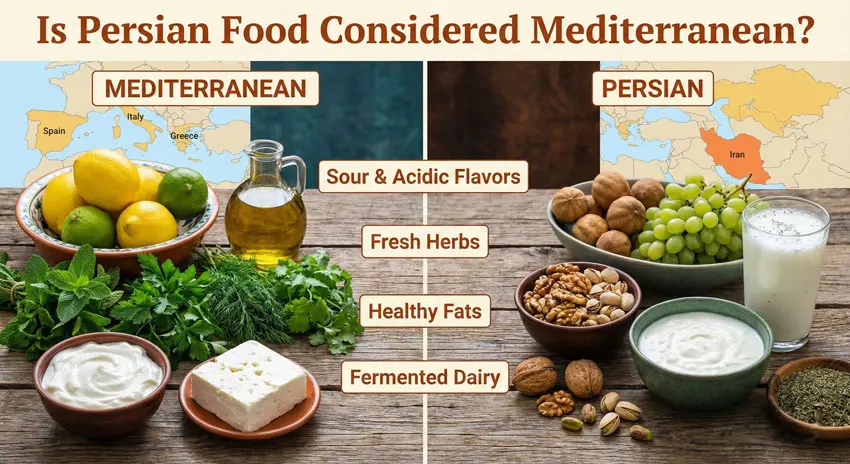
Many people confuse Persian food with Mediterranean food because they share a “flavor profile.” Both cuisines rely heavily on:
-
Sour & Acidic Flavors: Lime, lemon, and yogurt.
-
Fresh Herbs: Mint, parsley, dill, and cilantro.
-
Healthy Fats: Olive oil (Mediterranean) and quality dairy/nuts (Persian).
-
Fermented Dairy: Yogurt, cheese, and Doogh.
However, the distinction lies in geography. The Mediterranean diet comes from countries bordering the Mediterranean Sea (like Italy, Greece, Spain, and Turkey). Iran is located in the Middle East and Central Asia. Therefore, Persian food is technically Middle Eastern cuisine, historically influenced by the Silk Road spices rather than the Mediterranean coast.
Persian Food vs. Mediterranean Food: The Key Differences
While a Greek Gyro and a Persian Kebab might look similar, the ingredients and cooking methods differ significantly. Here is the ultimate comparison to help you spot the difference.
Comparison Table: Persian vs. Mediterranean Cuisine
| Feature | Mediterranean Cuisine | Persian Cuisine |
|---|---|---|
| Primary Region | Southern Europe (Greece, Italy, Spain) | Iran (Middle East / Central Asia) |
| Main Carbohydrate | Bread (Pita, Loaf), Pasta | Rice (Basmati with Saffron), Bread (Naan) |
| Key Spices | Oregano, Basil, Rosemary, Garlic | Saffron, Turmeric, Dried Lime, Cardamom |
| Fat Source | Olive Oil (Dominant) | Butter, Ghee, Animal Fats, Oils |
| Flavor Profile | Herbal, Garlicky, Salty | Sour, Aromatic, Floral (Rose water) |
| Signature Dish | Greek Salad, Hummus, Pasta | Ghormeh Sabzi, Kebab Koobideh, Fesenjan |
1. Rice vs. Bread
The biggest giveaway is the carb source. In Mediterranean cuisine (especially Italian or Greek), bread and pasta are staples. In Iran, rice is king. Persian cuisine is famous for its elaborate rice dishes (Polow), often steamed with saffron and served with a crispy bottom layer called Tahdig.
2. Saffron vs. Oregano
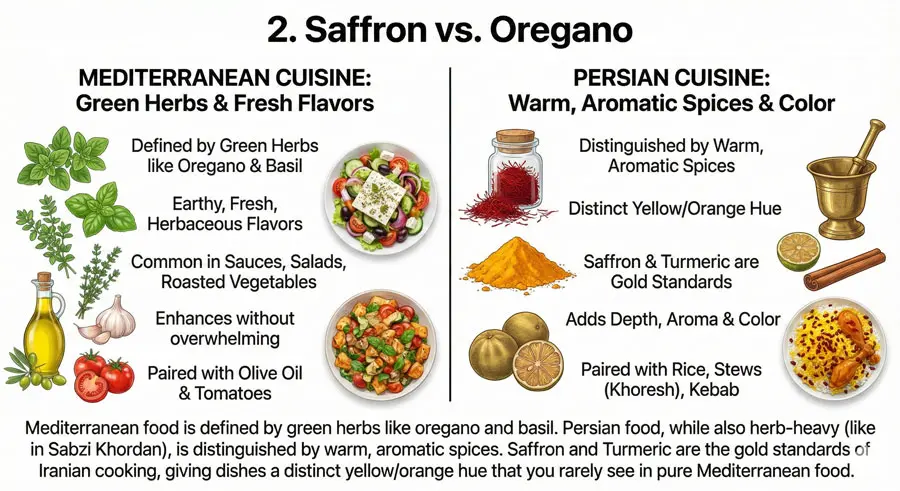
Mediterranean food is defined by green herbs like oregano and basil. Persian food, while also herb-heavy (like in Sabzi Khordan), is distinguished by warm, aromatic spices. Saffron and Turmeric are the gold standards of Iranian cooking, giving dishes a distinct yellow/orange hue that you rarely see in pure Mediterranean food.
3. Sourness vs. Saltiness
Persian food has a unique obsession with sour flavors. While Mediterranean food uses lemon and vinegar, Iranians use Dried Limes (Limoo Amani), sour grapes, pomegranate molasses, and sumac to achieve a deep, complex tartness that is unique to the region.
Is Persian Food Middle Eastern or Mediterranean?

This is a common confusion. Iran is a non-Arab country located in the Middle East. Unlike Lebanese or Turkish cuisine, which are considered “Eastern Mediterranean,” Persian cuisine developed independently on the Iranian plateau.
-
Persian vs. Lebanese Food: Lebanese food (like Hummus, Tabouli, Baba Ganoush) is Mediterranean. Persian food does not traditionally include Hummus. Instead, Persians serve Mast-o-Khiar (Yogurt and Cucumber) or Mirza Ghasemi (Smoked Eggplant).
-
Persian vs. Greek Food: Both love grilled meats (Souvlaki vs. Kebab). However, Greeks use olive oil and oregano marinades, while Persians use onion juice, saffron, and yogurt for marinating meats.
Health Benefits: Is Persian Food Healthy?
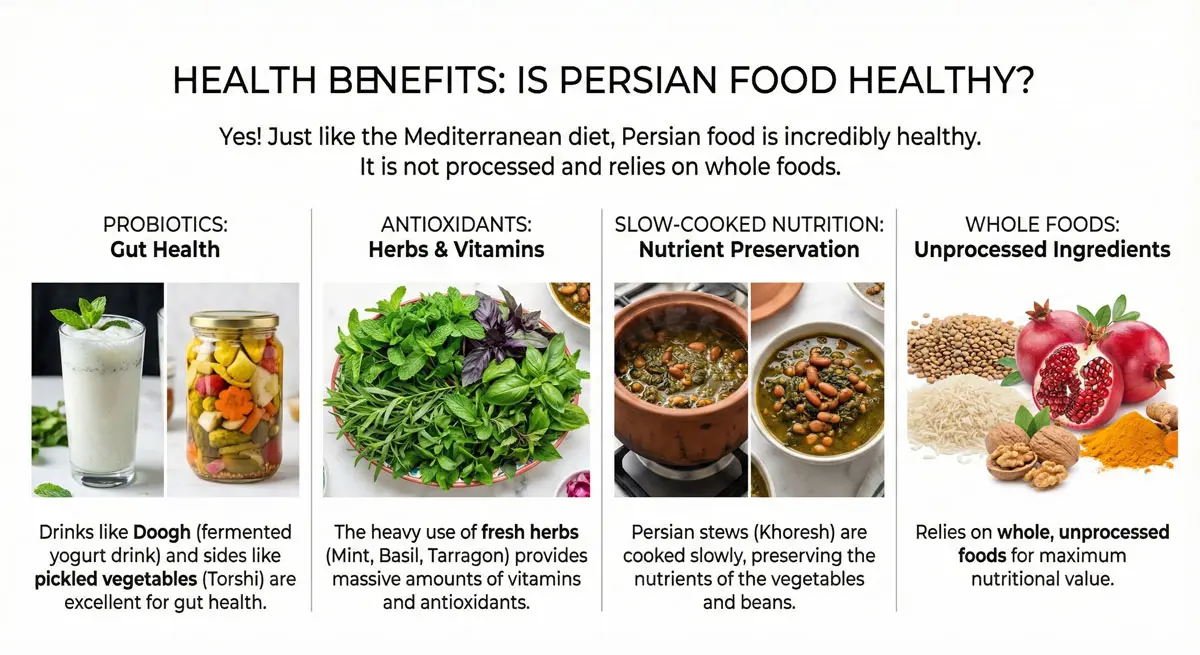
Yes! Just like the Mediterranean diet, Persian food is incredibly healthy. It is not processed and relies on whole foods.
-
Probiotics: Drinks like Doogh (fermented yogurt drink) and sides like pickled vegetables (Torshi) are excellent for gut health.
-
Antioxidants: The heavy use of fresh herbs (Mint, Basil, Tarragon) provides massive amounts of vitamins and antioxidants.
-
Slow-Cooked Nutrition: Persian stews (Khoresh) are cooked slowly, preserving the nutrients of the vegetables and beans.
In this video, a blogger is testing Iranian and Greek food, which can be interesting for you and help you understand the difference between Persian cuisine and Mediterranean cuisine.
FAQ
1. Is Persian food the same as Mediterranean? No, they are distinct. Persian food is from the Middle East (Iran) and focuses on rice and saffron, while Mediterranean food comes from Southern Europe and focuses on olive oil and bread. However, they share many healthy ingredients.
2. Is Persian food spicy? No. Unlike Indian cuisine, Persian food is not “hot” spicy. It is flavorful and aromatic, using spices like turmeric, saffron, and rose petals, but it does not burn your tongue.
3. Is Iranian food healthy? Yes. Traditional Iranian food is balanced with proteins, grains, and lots of vegetables. It is low in processed sugars and high in fiber and probiotics.
4. Does Persian food have hummus? Traditionally, no. Hummus is an Arab/Levantine dish (Lebanese, Palestinian, etc.). The Persian equivalent appetizer is usually a yogurt-based dip like Mast-o-Mosir (Yogurt and Shallot) or Kashk-e-Bademjan (Eggplant dip).




I used to follow a Mediterranean diet and I was very satisfied, but I got tired and today I read this article. I would really like to try the Iranian diet, but I am not sure about the calories and fat.
hello my dear friend
I am very happy that you want to experience the Iranian diet
Don’t worry, you can follow my articles step by step
I have a whole article about the calories in Iranian food and about being healthy and Iranian food.
And that in the recipe section, you have free access to all Iranian food recipes.
Tell me any food you needed and it wasn’t there, and I will email you and post it on the website. What else do you want? Start today.
You can’t really find dishes like Ghormeh Sabzi and Kobbideh, not in Mediterranean cuisine, but anywhere in the world.
yes exactly
Due to the presence of special local vegetables and recipes that only Iranian cooks know, these dishes are really special
Which cuisine is healthier, Persian or Mediterranean?
Both are healthy, but Mediterranean food is often seen as slightly healthier due to its heavy reliance on olive oil and seafood, which are rich in omega-3s and low in saturated fats. Persian cuisine, while also healthy, tends to use more animal fat and focuses on stews and rice dishes