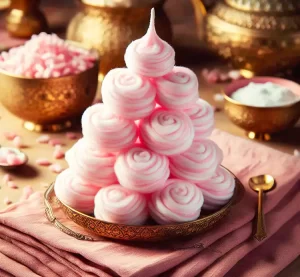


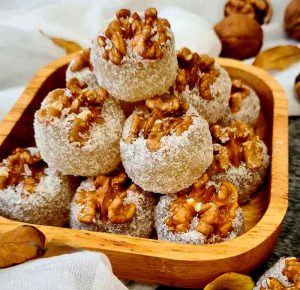
Think of Baslogh as the Persian cousin of Turkish Delight (Lokum), but nuttier and softer. Unlike Turkish Delight, which is purely sugar-based, Baslogh uses wheat starch for a unique, chewy texture. It is usually served with hot drinks, such as Persian tea.
This sweet is a classic souvenir from cities like Maragheh and Arak. It is a staple for winter festivities, especially Yalda Night (Shab-e Yalda) and Persian New Year (Nowruz).
Making Baslogh at home is easier than you think. While the traditional method requires patience, the result is a fragrant, rose-water-infused pastry that melts in your mouth.
Now, Meals Cook is at your service to teach you how to prepare this traditional and suitable sweet, which is usually served on Eid Nowruz days, and to give you all the necessary tips to make it tastier. So be with us.
For: 20 Pieces
Preparation time: 20 minutes
Cooking time: 40 minutes
110 kcal 1 piece (30g)
Ingredients:
| Ingredient | Original Amount | Weight (Metric – g) | Weight (Imperial – lb/oz) |
| Wheat Starch (Gol-e Neshasteh) | 1 cup | ~ 130 g | ~ 4.5 oz (0.28 lb) |
| Cold Water | 2 cups | ~ 470 g | ~ 1 lb |
| Sugar | 1 cup | ~ 200 g | ~ 7 oz (0.44 lb) |
| Gelatin Powder | 2 tablespoons | ~ 20 g | ~ 0.7 oz |
| Rose Water | 1/2 cup | ~ 120 ml | ~ 4 fl oz |
| Butter | 2 tablespoons | ~ 25 g | ~ 0.9 oz |
| Citric Acid (Johar Limoo) | 1/8 tsp | < 1 g | Negligible |
| Walnut Halves | As needed | – | – |
| Desiccated Coconut | As needed | – | – |

Instruction :
The recipe for Walnut Baslogh is similar to Masghati but has a firmer texture suitable for shaping.
1. Bloom the Gelatin:
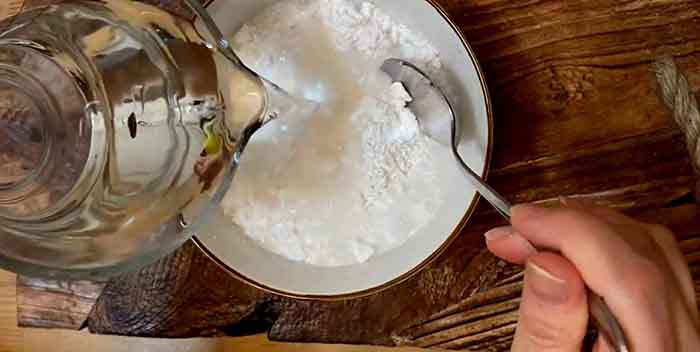
In the first step, sprinkle the gelatin powder over 1/2 cup of cold water. Let it sit for 5 minutes to bloom. Then, place the bowl over a pot of simmering water (double boiler method) or microwave it until the gelatin dissolves completely and becomes transparent.
2. Dissolve the starch in water:

Pour 1 cup of wheat starch and 1 cup of cold water into a bowl. Stir well until the starch is completely dissolved and no lumps remain. (Note: Use high-quality refined wheat starch. Do not use cornstarch, as it changes the texture).
3. Make the Syrup:
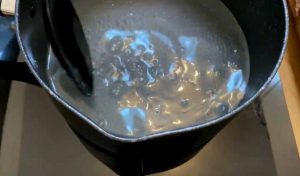
Pour the sugar and the remaining 1 cup of water into a non-stick pot. Heat until it boils. Add the citric acid (or 1 tsp lemon juice) and mix well.
4. Cook the Mixture:

Add the dissolved starch mixture to the pot. Stir continuously with a wooden spoon on low heat. This is the most important step. Keep stirring for 15-20 minutes until the mixture thickens, becomes translucent, and the raw smell of starch is completely gone.
5. Add gelatin and rose water :
Once the mixture thickens to a dough-like consistency, add the bloomed gelatin and stir until homogeneous. Then, pour in the rose water and mix well.
6. Final Consistency:

Add the butter and mix until melted. Continue stirring until the mixture pulls away from the sides of the pot and forms a soft, shiny ball in the center. Turn off the heat and let it cool down slightly (it should be warm enough to handle, but not hot).
7. Shaping :


Pour desiccated coconut onto a tray. ~~Make some of the ingredients into balls~~ Take a walnut-sized amount of the warm paste, shape it into a ball, and roll it in the coconut powder to coat. Press a walnut half into the center of each piece. Let them set in the refrigerator for 1-2 hours before serving.
This Persian sweet can be served as an evening meal with Persian Noghl and Haji Badam with coffee, along with a delicious Iranian version.

Chef’s Tips for Perfect Baslogh
-
Wheat Starch vs. Cornstarch: ~~Use wheat flour instead of starch…~~ Always use Wheat Starch (Gol-e Neshasteh) for authentic Baslogh. Cornstarch will make the texture too soft and jelly-like (like pudding), whereas wheat starch gives it that signature chewiness.
-
Stirring: Patience is key. You must cook the starch on low heat for at least 20 minutes to remove the raw flour taste.
-
Storage: ~~For long-term storage, put this in a closed bowl…~~ Store Baslogh in an airtight container in the fridge for up to 2 weeks. If left uncovered, it will dry out and crack.
FAQ
1. Why did my Baslogh become too soft? This usually happens if the starch wasn’t cooked long enough or if the ratio of water was too high. Make sure the mixture pulls away from the pot sides before turning off the heat.
2. Can I use cornstarch? Technically, yes, but the texture will be different. Cornstarch makes it like “Masghati” (softer jelly), while Wheat Starch makes it chewy and firm enough to hold its shape.
3. Is this dessert Gluten-Free? It depends on the starch. Pure Wheat Starch can be gluten-free if processed to remove gluten proteins (Codex wheat starch), but standard wheat starch may contain traces. For a strictly gluten-free version, ensure your starch is certified GF.
4. How many calories are in Baslogh? Each piece of Walnut Baslogh (approx. 30g) contains about 90-110 calories, depending on the size of the walnut and the sugar used.