

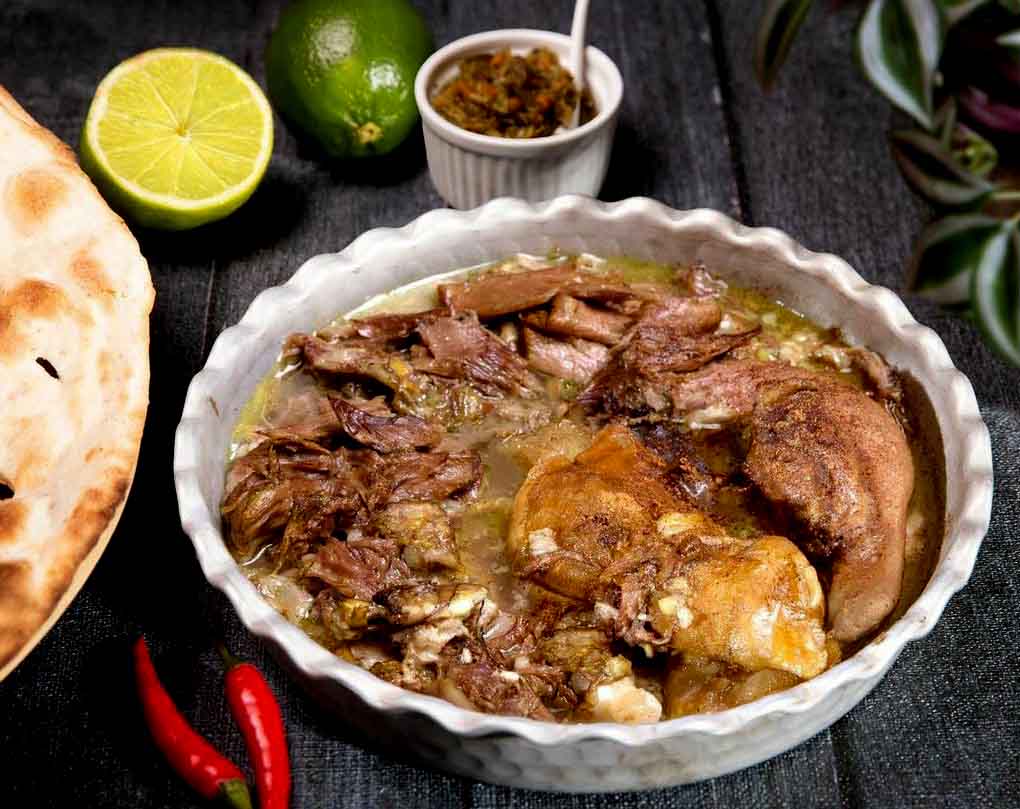
Kale pache is one of the most traditional Persian breakfast dishes, usually made with sheep head and feet, slowly cooked until tender. It is a rich, heavy, and deeply cultural dish in Iran, often served early in the morning with fresh bread, lemon juice, cinnamon, and sometimes garlic.
This recipe explains how kaleh pacheh is prepared in a traditional Persian way, while also giving practical tips for cleaning, cooking time, seasoning, and serving. Because this dish has a strong flavor and texture, the slow cooking process is the key to making it tender and enjoyable.
What is Kale Pache(Iranian Sheep Head Dish)?

Kale Pache is a traditional Persian dish made from the head, feet, and other parts of a sheep, slowly cooked with spices to create a flavorful and nutrient-dense meal.
It is often accompanied by Sangak bread and lemon juice, making it a distinctive breakfast in Iran and Afghanistan.
The broth is consumed as a starter, while the meat is enjoyed as the main part of the meal. With its rich taste and high-calorie content, this is considered a complete meal that is best consumed in the morning.
Preparation and Cooking Time:
- Preparation Time: 2 hours
- Cooking Time: 10 to 12 hours
- Calories per 100g: 350 calories
- For 5 Servings
Ingredients :
| Sheep’s Head (kalepache) | 1 whole |
| Medium onion | 3 pcs |
| Garlic | 5 cloves |
| Turmeric powder | 1.5 teaspoon |
| Cinnamon stick |
1 pcs |
| Black pepper | 1 teaspoon |
| Salt | 2 tsp |
| Water | as needed |

Step-by-Step Guide to Cooking Kaleh Pacheh(How to cook sheep head and feet on the stove):

1. Buying and choosing :
The most important thing in cooking is to choose a fresh and high-quality sheep’s head first. Pay attention to this important point when buying it to distinguish goat kale pache from sheep.
For this, look at the sides of the eyes. If there is a hole next to both eyes, this is a sheep’s head.
2. The correct and principled method of cleaning a sheep’s head:

You can get it cleaned at the markets. It seems like you’re halfway there if you get this. But even if it is clean, you still have to clean it.
The method of cleaning this food is to first roast the various parts of it on a gentle gas flame until the hairs on and under the skin are removed and the skin is slightly roasted.
3. Correct and accurate washing :

One of the most important points in preparing delicious food is to wash it properly. Even if you have bought a clean one, put it in a pot, leave it in water for 15 minutes, and wash it.
Pour the food into the water and change the water until it is clear. Put the nose, ears, and tongue under water and rinse well.
Clean the teeth with a clean toothbrush and water. When you are completely sure that it is clean, start cooking it.
It is better to cut the head from the side of the tongue with a knife and pull it from both sides until it is half-cooked.
4. Cook the delicious leg of sheep along with its head:
First, we choose a suitable and big pot. We place 5 cleaned sheep’s feet on the bottom of the pot. Then we place the cleaned sheep’s head on the feet.
We pour water for the number of people who want to eat this food.
For example, if there are 5 of you, we will pour 5 water bowls. Then increase the heat and cover the pot until the water and ingredients boil.

6. We go to chop three onions. Cut the onions into slices. Then we go to the garlic, peel them and cut them in half.
7. After the water boils, take the foam kale pacheh with a big spoon.
After this, we will add spices. First, we add one and a half teaspoons of turmeric and then one teaspoon of black pepper.

8. Cut a cinnamon stick in half and add it to the pot. I always add cinnamon sticks instead of cinnamon powder because cinnamon powder makes the water cloudy.
9. Next, add chopped onion and garlic to the pot. Cover the pot and let it cook for 10 to 12 hours.

10. Separation and cleaning of cooked Kale Pache
After this time has passed and the giblets are completely cooked, there is a yellow oil on them. Transfer this oil with a spoon to another bowl and add it to the giblets at the end.

11. At this stage, we add two teaspoons of salt and let it cook with the ingredients for 10 to 15 minutes before eating.

12. At this stage, we separate the offal from the onion, garlic, and cinnamon powder, put it in another container, and let it cool a little.
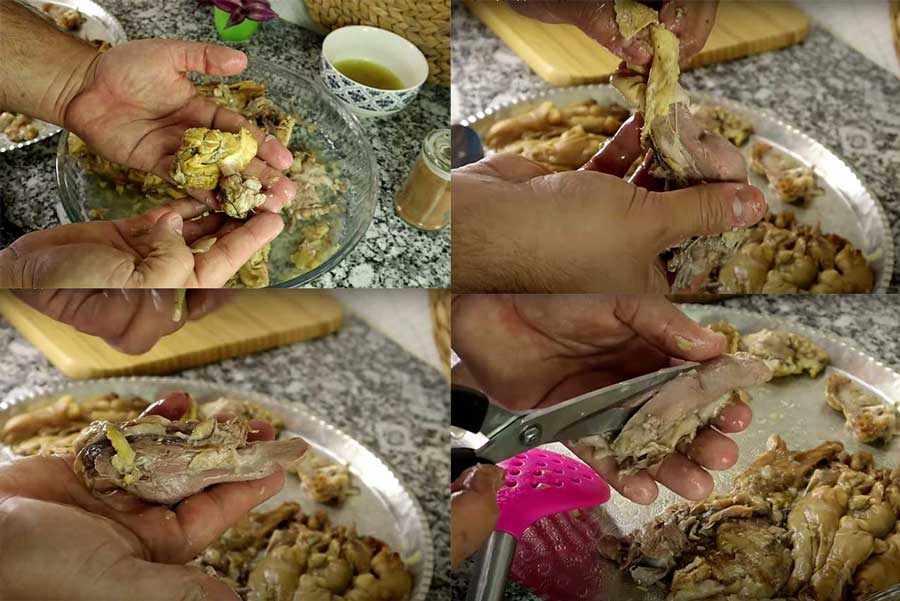
13. First, we easily separate the cartilage from the leg and place it in a large copper or metal container.

14. Then we go to the ear and separate its flesh from the face, and separate the yellow tissue inside the mouth and the cartilaginous part of the ear.

15. Then go to the eye and easily break the bones around the eye and separate the eye from the sheep’s head. With finger pressure, remove the black part of the eye that cannot be eaten and cut the eye itself or a knife in half.
Then we take out the lower jaw and separate the meat under the jaw, which can be eaten, and put it in the dish.

16. Then we go to the brain, and there is black skin on it, we remove it and put the brain in a dish to serve.
After that, we go to the sheep’s tongue and take the skin off it, which is not edible, and use scissors to divide the tongue into two parts.
17. We put all these ingredients in a copper or iron container that you can heat and pour a little of the juice, a teaspoon of cinnamon, and the oil on the ingredients, and heat it on a low heat.

Our kalepache is ready, and you can enjoy it with Iranian tea, Sangak bread, and fresh lemon.

How to Serve Sheep’s Head:
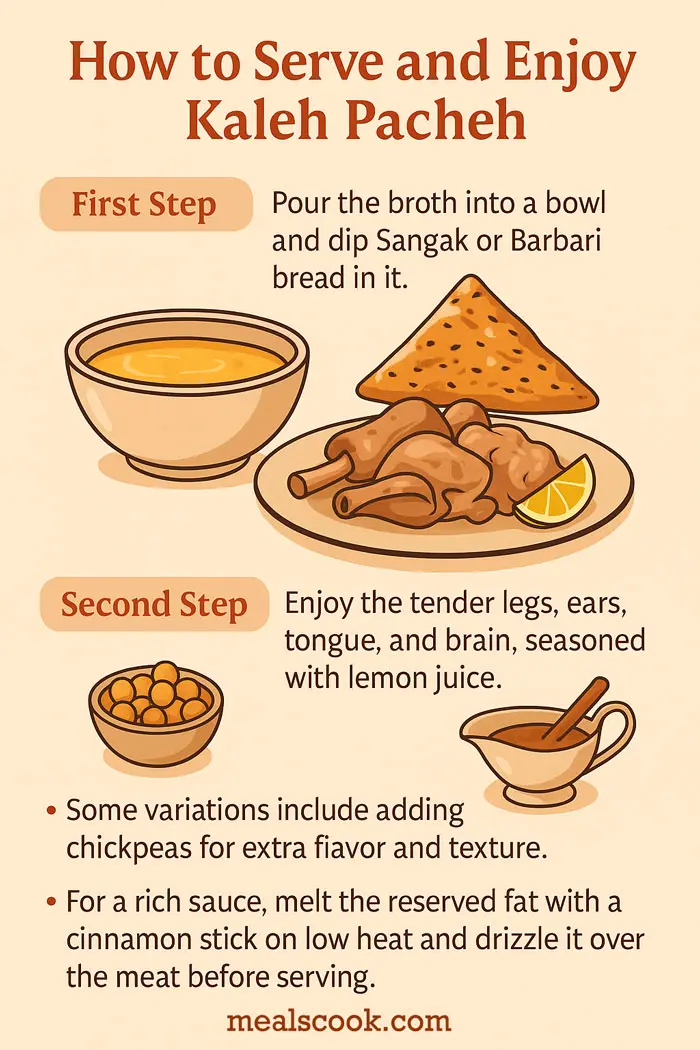
Kaleh Pacheh is an experience, not just a meal. Here is the traditional way to enjoy it:
-
-
Make “Tilit” First: Before eating the meat, tear pieces of flatbread (Sangak is best) into a bowl of hot broth. Let it soak up the juice and eat this first. We call this “Tilit.”
-
Balance the Flavor: Since the meat is rich and fatty, you need acid and spice. Squeeze plenty of fresh lime or lemon juice on top and sprinkle a good amount of cinnamon. It makes it taste amazing and helps with digestion.
-
The Sides: Don’t eat it alone! Serve it with raw onions, fresh herbs, and garlic pickle (Sir Torshi). The sharp taste balances the heavy meat.
-
Important Rule: Never drink cold water after this meal. Instead, finish with a cup of hot Persian tea and rock candy (Nabat) to help settle your stomach.
-
Kaleh Pacheh Origin:
Kale Pache is a traditional dish with ancient origins, which is between 3,000 to 4,000 years.
Archaeological discoveries near the city of Sankhasat in North Khorasan province show that eating this food was popular in ancient Iran, and Iranians have had a special interest in eating this delicious food since that time.
The results of the excavations in this city are 2 graves that date from 3,700 to 4,200 years ago, and in each of them, there were the remains of a hand.
This was probably the most popular food of the people of that time, which was given to them after death.
Of course, apart from this historical discovery, we can also refer to the poems of poets such as “Abu Ishaq Atameh,” one of the poets of the 8th and 9th centuries of Hijri.
Poems tell us that at that time, this food was considered one of the foods of the Iranian people. In addition to Iran, this food has many fans in Turkey, Armenia, Azerbaijan, and Georgia.
Of course, their names are also different in different countries. For example, in Iran and Turkey, it is called Kaleh pache; in Arab countries, it is called Pache; in Armenia, Azerbaijan, and Georgia, it is known as Khash.
This food is one of the delicious Iranian dishes that many people love. Like many Iranian dishes, this popular dish also has its history, and according to historical documents, it dates back centuries.
Today, this Persian breakfast has become a common food in some countries, and throughout history, it has influenced the tastes of various ethnic groups and cultures, from Turks and Kurds to Arabs and Caucasus countries.
Notes :

Conclusion:
Kale pache is a meal full of energy and one of the most traditional Iranian dishes, which is mostly consumed in breakfast due to its high calorie and fat content.
This traditional dish, contrary to its ugly appearance, has a great and delicious taste, and I suggest that you definitely try this very popular Iranian dish and share your opinions with me.
FAQ :

1. When should we eat sheep heads?
Kalepache is better to eat in the cold seasons of the year or for breakfast.
2. What should we eat for digestion?
Saving helps digestion.
3. How many calories are in kale pache?
The amount of calories in 100 grams of kale pache is 350 calories.
4. Where does Kale Pache come from?
Kalle Pache is 3500 years old, and this food comes from Iran.
5. Is Kale Pache good?
This Persian food is rich in vitamins and proteins and, at the same time, has a lot of calories. For this reason, it should be consumed for breakfast and is not suitable for dinner.
6. Can I cook Kaleh Pacheh in a pressure cooker?
Yes! In a regular pot, it takes 5-7 hours. In a pressure cooker (Instant Pot), it takes about 90 minutes to 2 hours.
7 . What is the best time to eat Kaleh Pacheh?
Traditionally, it is eaten early in the morning (breakfast) because it is very high in calories and fat, giving you energy for the whole day. It is heavy for dinner.
8. How do I store leftovers?
The broth turns into a jelly (gelatin) when cold. You can keep it in the fridge for 3 days or freeze it for up to 2 months.
9. What is the best bread to serve with it?
Sangak bread (traditional Persian stone bread) is the best choice. Tilit (soaking dry bread in the broth) is a must!
10 . How to reduce the fat?
Let it cool down slightly so the oil rises to the top, then skim off the excess yellow oil. Also, adding lemon juice or serving it with “Sir Torshi” (Garlic Pickle) helps cut through the fat.
Make this great Iranian breakfast today!
- What strange foods have you tried in your country?
- If you have the experience of eating strange but delicious food, share it with me on social networks by tagging @MealsCook.
- Make this great Iranian food today, and tell me about your taste and experience in the comments





Are you sure this food is delicious????????
Yes, don’t look at its appearance, it tastes great
How many calories in this sheep head and feet?
Hi dear Hana Each 100 grams of kaleh pache has about 350 calories
Hi dears
Can you also give some tips about the disadvantages of kaleh pacheh?
Thankful
Hi dear Katrina, kale pacheh, especially the brain, contains a lot of cholesterol, and for this reason, it causes the level of uric acid in the blood to rise. An increase in the level of uric acid in the blood leads to unpleasant side effects, among which we can mention the increased risk of gout and kidney problems.
Hi mr Mohsen , What is served with kale pacheh?
Can i served with this food pickled garlic?
Hi dear Ferancisca, along with kale pache is served sir torshi and zeytoon parvardeh, yes you can served this.
What is the meaning of kale pache?
Head and Legs of sheep is called Kaleh Pache
I traveled to Iran with my friend two years ago and I was scared when I saw this food
Because the cooked sheep’s head was very strange to me
But with the secrets of my friend, when I ate a piece of sheep’s tongue, I realized how delicious offal it is
These photos and step by step recipes reminded me of those days, thank you very much
Hello my dear friend, thank you for sharing your experience with me
Yes, Kale pache is very strange and maybe scary for someone who has never eaten this food
But once you try and taste the great taste of this dish, you will not be able to give it up
By the way, the best part of this dish is the sheep’s tongue, which is very delicious and excellent, with a little lemon juice and stone bread, it will bring you an unforgettable taste.
Hi chef Haghighi
What is Kale Pache made of?
Hi dear Mahoor Generally, kale pache is made of cooking the head, hands, and feet of sheep. The components of this food also include ears, tongue, brain, eyes, facial meat, and legs. The juice of this dish is eaten as an appetizer with bread.